Cyrillic Alphabet Tier List: Ranking Letters by Difficulty
Not all Cyrillic letters are created equal. Some are intuitive, friendly, and easy to remember. Others are soul-crushing nightmares that haunt your learning journey for weeks. Let's rank all 33 letters of the Russian alphabet by difficulty, from S-tier (easiest) to F-tier (why does this letter exist?).
This tier list is based on difficulty for English speakers learning to read Russian. We're considering: visual similarity to English, pronunciation difficulty, false friend potential, and overall brain-breaking capacity. The tiers rank how long a letter takes to become automatic, which is a different question from what kind of letter it is.
Not every false friend fools you equally, though. The damage is worst when the wrong reading still looks like it could be a word, because nothing flags the mistake: read Р as "P" and you keep getting words that seem like words, so the error survives for weeks. Read С as "C" or Х as "X" and you usually get obvious nonsense, which your brain catches and fixes fast.
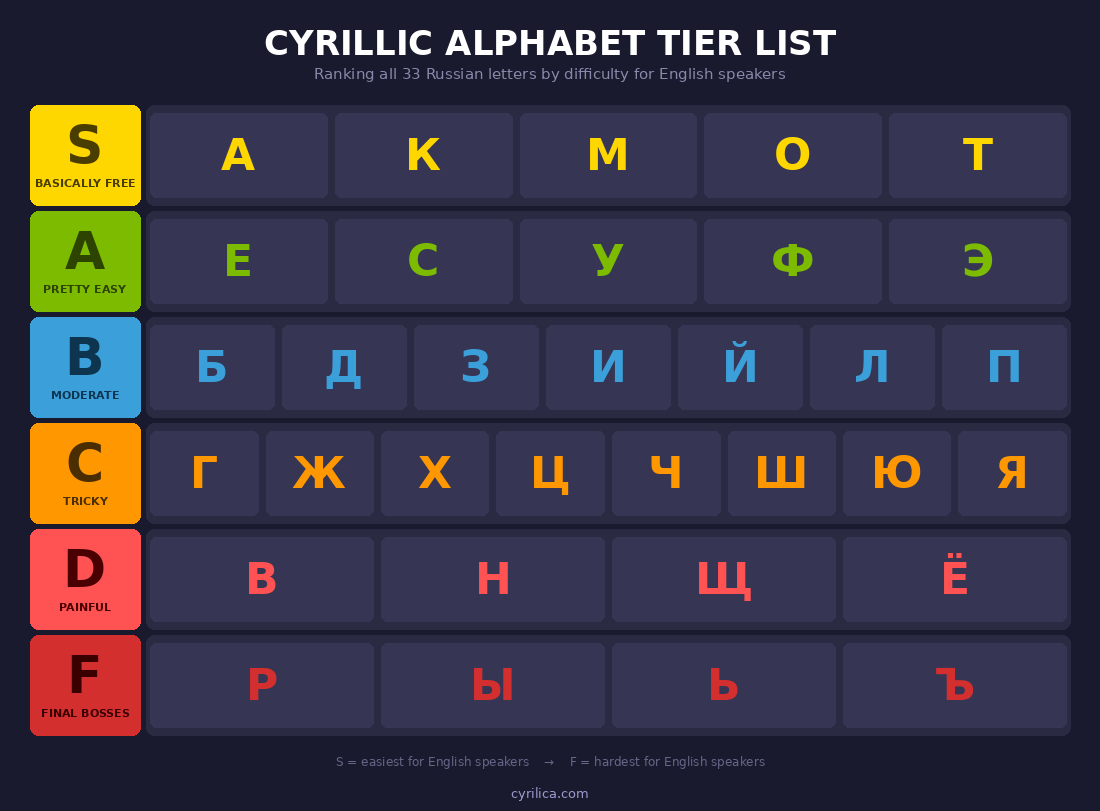
S-TIER: Welcome Gifts (Basically Free)
These letters look like English, sound like English, and require almost no effort to learn.
А (a): Looks like A, sounds like A. Perfect.
К (k): Looks like K, sounds like K. Chef's kiss.
М (m): Looks like M, sounds like M. Thank you, Cyrillic gods.
О (o): Looks like O, sounds like O. We love you.
Т (t): Looks like T, sounds like T. No notes.
Why S-tier: These are your gateway drug into Cyrillic. They give you immediate confidence and let you read simple words like "MAMA" (мама) and "KOT" (кот - cat) right away. Zero learning curve. Want more practice? Check out our guide to common Russian words using only easy letters.
A-TIER: Pretty Easy (Minor Adjustments)
These require slight mental adjustment but are still very learner-friendly.
Е (ye): Looks like E, sounds like "ye" in "yes." Close enough.
С (s): Looks like C, sounds like S. Makes sense once you realize Cyrillic doesn't have "C" sound.
У (u): Looks like Y, sounds like "oo." A bit weird but manageable.
Ф (f): Looks like Φ (Greek phi), sounds like F. Easy if you know Greek.
Э (e): Backwards E, sounds like "eh." Memorable shape.
Why A-tier: These require one mental hop (looks like X, sounds like Y) but the jump is small.
B-TIER: Moderate Challenge (New Territory)
These letters look unfamiliar but are phonetically straightforward.
Б (b): Looks like a number 6, sounds like B. Weird but works.
Д (d): Looks like a house, sounds like D. Once you see it, you can't unsee it.
З (z): Looks like a 3, sounds like Z. Makes sense.
И (i): Backwards N, sounds like "ee." Annoying but memorable.
Й (y): И with a breve, sounds like Y in "boy." Short and sweet.
Л (l): Looks like an upside-down V, sounds like L. Weird shape, simple sound.
П (p): Looks like a Greek pi, sounds like P. Greek knowledge helps.
Why B-tier: These look alien but have straightforward sounds. Once you memorize the shapes, you're good. No false friends, no pronunciation nightmares.
C-TIER: Tricky Business (Concentration Required)
These letters demand your full attention and will cause mistakes even after you've "learned" them.
Г (g): Looks like an upside-down L, sounds like G. Not intuitive.
Ж (zh): Looks like a bug, sounds like "zh" in "measure." Exotic sound.
Х (kh): Looks like X, sounds like the throaty "kh" in "Bach." A false friend, but a weak one. English just doesn't have this sound.
Ц (ts): Looks like a squiggly U, sounds like "ts" in "cats." Combo sound is hard.
Ч (ch): Looks like a 4, sounds like "ch." Takes practice.
Ш (sh): Looks like Ш, sounds like "sh" in "shoe." Fine once memorized.
Ю (yu): Looks like a sideways lollipop, sounds like "yoo." Visually weird.
Я (ya): Mirrors an R, sounds like "ya." Common source of memes.
Why C-tier: These require real effort. The shapes don't hint at the sounds, and some sounds don't exist in English. You'll get there, but it takes deliberate practice.
D-TIER: Serious Pain Points (Study Required)
These letters will actively fight you. They look wrong, sound wrong, or both.
В (v): FALSE FRIEND ALERT. Looks exactly like B, sounds like V. Your brain will fight this for weeks. Every. Single. Time.
Н (n): FALSE FRIEND ALERT. Looks exactly like H, sounds like N. You'll misread it as H approximately one million times.
Щ (shch): Looks like a longer Ш, sounds like "sh-ch" mashed together. Hard to pronounce for English speakers. Why is this one letter?
Ё (yo): E with dots, sounds like "yo." Easy except written Russian often leaves the dots off, so you have to guess when it's Ё vs Е.
Why D-tier: False friends are brutal. Your brain sees В and instantly thinks "B" even though you KNOW it's V. Щ is just phonetically annoying for English speakers. Ё is fine except for the "dots are optional" chaos.
F-TIER: The Final Bosses (Abandon Hope)
These letters are the reason people quit learning Cyrillic.
Р (r): THE ULTIMATE FALSE FRIEND. Looks EXACTLY like P, sounds like R. This is the letter that breaks people. You'll be reading along fine, see РЕСТОРАН (restaurant), and your brain will scream "PECTOPAH!" even though you've practiced this a thousand times. It never stops being annoying.
Ы (y): THE NIGHTMARE VOWEL. Looks like a weird Ь + I combo, sounds like... nothing in English. It's like "i" but with your throat positioned wrong. English speakers physically can't make this sound without practice. Russians can hear when you get it wrong. This letter haunts dreams.
Ь (soft sign): THE INVISIBLE VILLAIN. Doesn't make a sound. Just... softens the previous consonant. What does that even mean? How do you soften a consonant? Why is this a letter? It's a phonetic modifier masquerading as a letter and it's confusing as hell.
Ъ (hard sign): THE RARE ONE. One of the rarest letters in the alphabet. In modern Russian it separates a prefix ending in a consonant from a following я, е, ё or ю. What did we do to deserve this?
Why F-tier: Р is the false friend that never stops being a false friend. Ы is a sound your mouth doesn't want to make. Ь is conceptually weird. Ъ barely exists. These are your final bosses in the Cyrillic learning journey.
Think you can handle the S-tier letters? The study tool does not sort letters by tier. It uses six groups of vowels and consonants, and the five S-tier letters sit in three of them: А and О in Vowels 1, К and М in Consonants 2, and Т in Consonants 3. Select those three groups and you will practice all five, alongside 12 other letters.
The Learning Journey
Treat the weeks as a sequence, not a deadline: if one needs longer, give it longer.
Week 1: Master S-tier and A-tier. Feel good about yourself. (10 letters down!)
Week 2: Conquer B-tier. Still making good progress. (17 letters!)
Week 3: Battle through C-tier. Progress slows but you're committed. (25 letters!)
Week 4: D-tier makes you question your life choices. The false friends are winning. (29 letters...)
Week 5-∞: F-tier. You thought you learned Р three weeks ago. You were wrong. Ы still sounds weird when you say it. Ь remains conceptually frustrating. But slowly, painfully, you're getting there.
The Reward
Here's the thing: even the F-tier letters eventually click. One day you'll see РЫБА (fish) and just read it as "RYBA" without your brain screaming "PYBA!" at you. One day Ы will come out of your mouth naturally. One day you'll understand what Ь actually does.
The tier list tells you the order of difficulty, not a timeline. S-tier letters come almost free. F-tier letters take the longest. But they all become automatic eventually.
And then you can make tier lists for other Cyrillic alphabets and discover that Ukrainian's Ґ is somehow even weirder than anything Russian has. But that's a problem for future you.
For now, celebrate every tier conquered. Even F-tier letters can't resist forever. You've got this.