The Lost Letters of Cyrillic: A Journey Through Extinct Characters
You've mastered the 33 letters of the modern Russian alphabet. Congratulations! But here's a secret: you've only scratched the surface. Throughout its 1,150-year history, the Cyrillic alphabet has shed letters: the earliest version had somewhere between 43 and 46, depending on the source, against the 33 of modern Russian, and most of the ones that dropped out have vanished into the mists of time.
This is the story of the lost letters: the characters that once filled medieval manuscripts, adorned church texts, and puzzled scribes across Eastern Europe. Some disappeared centuries ago. Others survived until your great-grandparents' generation. All of them tell a fascinating story about how writing systems evolve.
The Iceberg of Cyrillic
If you've spent any time on language learning forums, you might have seen the "Cyrillic iceberg" meme, a tiered chart showing the descent from common letters everyone knows to increasingly obscure, archaic, and downright bizarre characters that would make medieval monks scratch their heads.
At the surface level, you have the familiar 33 letters of Russian. Dive a bit deeper, and you find letters from other modern Cyrillic alphabets: Ukrainian Є and Ї, Serbian Ђ and Ћ. Go deeper still, and you enter the realm of the recently extinct, then the medieval, and finally the utterly obscure letters that even linguists rarely encounter.
Let's descend into this iceberg and meet some of these lost characters.
The Famous Four: Killed in 1918
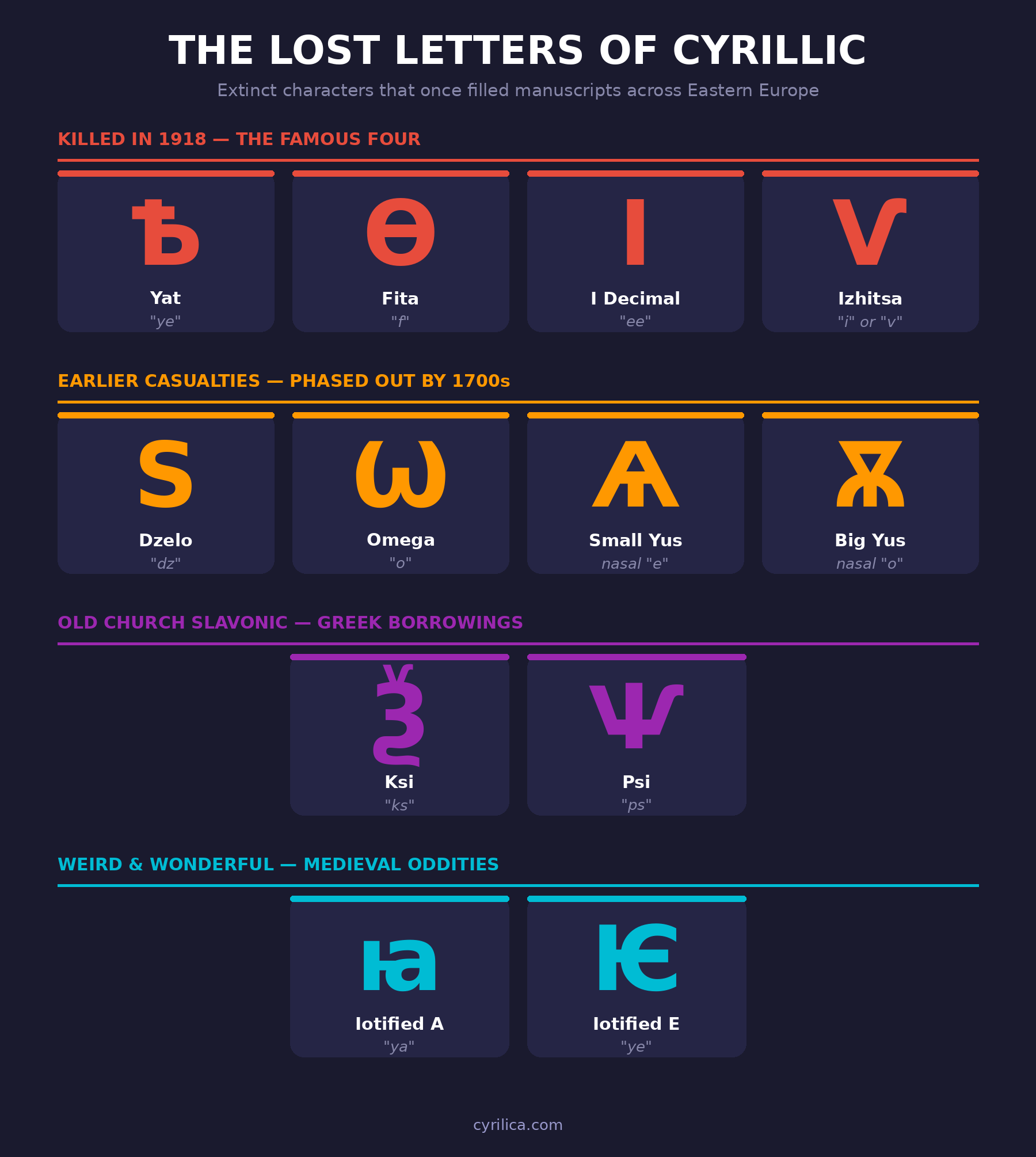
The most recent extinction event in Russian was the spelling reform of 1917 and 1918. It was drafted by an academic commission years before the revolution and promulgated by the Provisional Government in 1917. The new Soviet government then enforced it with two decrees: one dated 23 December 1917 (5 January 1918 in the new calendar) for state publications, and one on 10 October 1918 that made it binding on all state editions and documents. The decree named three letters, yat, fita, and the decimal І. The fourth, izhitsa, had already fallen out of use and was not even mentioned, but it vanished with them. If you're reading pre-revolutionary Russian literature in the original, you'll encounter these constantly:
Ѣ: Yat (sounds like "ye")
This letter looked like a Ь with a tall stem and a crossbar through it, and represented a sound that had already merged with Е (ye) in pronunciation by the 1700s. By 1918, people were spelling it out of pure tradition: everyone said "ye" but some words were written with Е and others with Ѣ, with no phonetic difference.
The letter was so notorious for being difficult to learn that "знать на ять" (to know yat) became a Russian idiom meaning "to know something perfectly." Students had to memorize long lists of which words used Ѣ versus Е.
Example: ХЛѢБЪ (bread) was written with yat, but pronounced exactly like modern ХЛЕБ.
Ѳ: Fita (sounds like "f")
This letter represented the "f" sound, but only in words borrowed from Greek (like "theater" or "Theodore"). Russian already had Ф for the "f" sound, making Ѳ completely redundant. The 1918 reform killed it, and all its words were respelled with Ф.
Example: ѲЕАТРЪ became ТЕАТР (theater)
І: I Decimal (sounds like "ee")
Russian had two letters for the "ee" sound: И (used in most words) and І (used before vowels and in the word "world"). The reform eliminated І in favor of just using И everywhere.
Example: МІРЪ became МИР (world/peace)
Ѵ: Izhitsa (sounds like "i" or "v")
This was the rarest of the four, appearing only in church-related words borrowed from Greek. By 1918, it was already nearly extinct in everyday writing. It looked like a Latin V but sounded like "i" in most contexts.
Example: МѴРО (sacred oil) became МИРО
These four letters disappeared from standard Russian with the 1918 reform, though you'll still see them in reproductions of old texts, church literature, and deliberately archaic writings.
The Earlier Casualties
Before 1918, other letters had already been quietly phased out:
Ѕ: Dzelo (sounds like "dz")
This letter represented the "dz" sound (like the "ds" in "suds"). It fell out of use in Russian by the 1700s but survived longer in other Slavic languages. You can still see it in Old Church Slavonic texts.
Ѡ: Omega (sounds like "o")
Russian borrowed this letter from Greek, where it represented a long "o" sound. But Russian doesn't distinguish between long and short vowels, so Omega was always redundant with the regular О. It hung on in some church texts until the 1700s.
Ѧ and Ѫ: The Nasals
These letters represented nasal vowels (like the "on" in French "bon"). Early Slavic languages had nasal vowels, but Russian lost them around the 1000s. The letters disappeared shortly after, though they survived in other manuscripts for centuries.
The Old Church Slavonic Collection
When Saints Cyril and Methodius created the first Slavic alphabet in the 860s (actually called Glagolitic, but that's another story), they needed letters for sounds that existed in Slavic but not in Greek. And they needed letters for sounds in Greek that didn't exist in Slavic, because they were translating Greek religious texts.
The result was an alphabet with 40+ letters, including many that seem bizarre today:
Ѯ: Ksi (sounds like "ks")
Ѱ: Psi (sounds like "ps")
Ѳ: Theta (sounds like "th" then "f")
These were all borrowed from Greek for writing Greek loan words. When people stopped caring about precise Greek pronunciation, these letters became redundant.
Ь and Ъ: The Mysterious Yers
These two letters, called "soft sign" and "hard sign," actually had vowel sounds in Old Church Slavonic, sort of a short "i" and short "u". Over centuries, the vowel sounds disappeared in most positions, and the letters evolved into purely grammatical markers. The soft sign Ь survived (it softens the previous consonant). The hard sign Ъ barely survived and is rarely used in modern Russian.
The Weird and Wonderful
Then there are the letters that make even medievalists do a double-take:
Ꙗ: Iotified A
This looks like a backwards "Я" and represented "ya" at the beginning of words. It was redundant with regular Я and disappeared early.
Ѥ: Iotified E
Represented "ye" at the start of words, eventually merged with regular Е.
Ѭ: Iotified Big Yus
One of the most complex letters, a ligature of big yus with decimal i, representing a iotified nasal "o" sound. Used in Old Church Slavonic texts, gone by the 1200s in most places.
Why Did They Disappear?
Letters die for the same reasons words do: they become redundant, the sounds they represent change or merge with other sounds, or deliberate spelling reforms eliminate them. Here are the main culprits:
1. Sound Changes
Languages are always evolving. When Russian lost its nasal vowels around the year 1000, the letters Ѧ and Ѫ became useless. When the pronunciations of Ѣ and Е merged, keeping both letters was pure tradition.
2. Foreign Sounds
Letters like Ѳ (fita) only existed to spell Greek loan words "correctly." As Russians cared less about matching Greek pronunciation, these letters lost their purpose.
3. Spelling Reforms
The big one was 1918, but there were smaller reforms in the 1700s under Peter the Great. Each reform simplified the alphabet, removing redundant or confusing letters.
4. Printing Technology
Before the printing press, scribes could draw any letter they wanted. But printing requires physical type pieces. The more letters you have, the more expensive and complicated printing becomes. This created pressure to simplify.
Where Can You Still See Them?
These lost letters aren't completely gone. You can still encounter them in:
Pre-1918 Literature
Any Russian book printed before 1918 will have Ѣ, Ѳ, and І. Only a few will have Ѵ, which was already rare by then. This includes original editions of Tolstoy, Dostoevsky, Pushkin, and Chekhov.
Church Texts
The Russian Orthodox Church still uses pre-reform spelling in liturgical books, so you'll see all four 1918 casualties plus some older letters in church Slavonic texts.
Historical Documents
Museums, archives, and historical reproductions preserve these letters. Old street signs, gravestones, and official documents show the letters in their natural habitat.
Deliberate Archaism
Sometimes modern Russian will use pre-reform spelling for nostalgic or artistic effect, like using "Ye Olde" in English. Restaurant signs, product names, and retro designs might include a Ѣ or two.
Other Cyrillic Alphabets Remember What Russian Forgot
Interestingly, some letters that died in Russian survived in other Cyrillic alphabets:
Ѕ (dzelo) survives in Macedonian
Ѣ (yat) was used in Bulgarian until 1945
І (i decimal) is still used in Ukrainian and Belarusian
Various Old Church Slavonic letters appear in academic editions of medieval texts
So while these letters are "lost" to Russian, they're not entirely extinct. They just moved to different neighborhoods.
The Lesson of Lost Letters
The story of Cyrillic's lost letters teaches us something profound: writing systems are not permanent. They evolve, simplify, and adapt to the needs of their users. Every letter in today's Russian alphabet could theoretically disappear if it became redundant or if a reform eliminated it.
The 33 letters you're learning are just the current snapshot of a writing system that started with 40+ letters and has been continuously refined for over a millennium. Some letters we use today might be "lost letters" to future Russian learners, and who knows what new letters might be added?
So the next time you're frustrated about learning Cyrillic, remember: you're getting the streamlined, user-friendly version. Imagine trying to memorize which words use Ѣ versus Е when they sound exactly the same, or remembering that "theater" uses Ѳ but "telephone" uses Ф!
The Really Deep Cut: Letters Even Scholars Debate
At the bottom of the Cyrillic iceberg are letters so obscure that their pronunciation, usage, and even authenticity are debated by paleographers:
Letters that appear in only one or two manuscripts
Variant forms that might be scribal errors or intentional letters
Abbreviation marks that might have been separate letters
Numerals that doubled as letters in Cyrillic's gematria system
These are the domain of specialist scholars, the kind who spend careers analyzing medieval manuscripts. They're the truly lost letters, not just removed from the alphabet, but lost to history and memory.
Your Challenge
Next time you see pre-revolutionary Russian text, try to spot the extinct letters. Can you find the Ѣ (yat)? Notice the І instead of И? See if there's a Ѳ (fita) in "ѲЕДОРЪ" (Theodore)?
Or go really deep: visit a Russian Orthodox church and look at their service books. You'll see an alphabet that most Russians couldn't read fluently, their own writing system frozen in time, preserved like a linguistic fossil.
The lost letters are gone, but the 33 that survived are waiting for you. Learn them all with our free interactive quiz.
The modern Russian alphabet is sleek, efficient, and relatively easy to learn. But lurking beneath it is a vast history of lost letters, characters that served their purpose, outlived their usefulness, and faded into history. They're gone, but they left their mark on the language, the culture, and the endless Cyrillic iceberg memes that language learners love to share.
Want another letter with a strange history? Check out the story of Ё, a modern Russian letter that's still fighting for consistent use two centuries after it was invented.