Belarusian Alphabet Guide: 32 Letters of Eastern Europe
Nestled between Russia, Ukraine, Poland, Latvia, and Lithuania, Belarus uses a Cyrillic alphabet that's distinct from its neighbors, a 32-letter system that reflects both Russian influence and uniquely Belarusian sounds. If you've learned Russian, Belarusian will feel familiar yet intriguingly different.
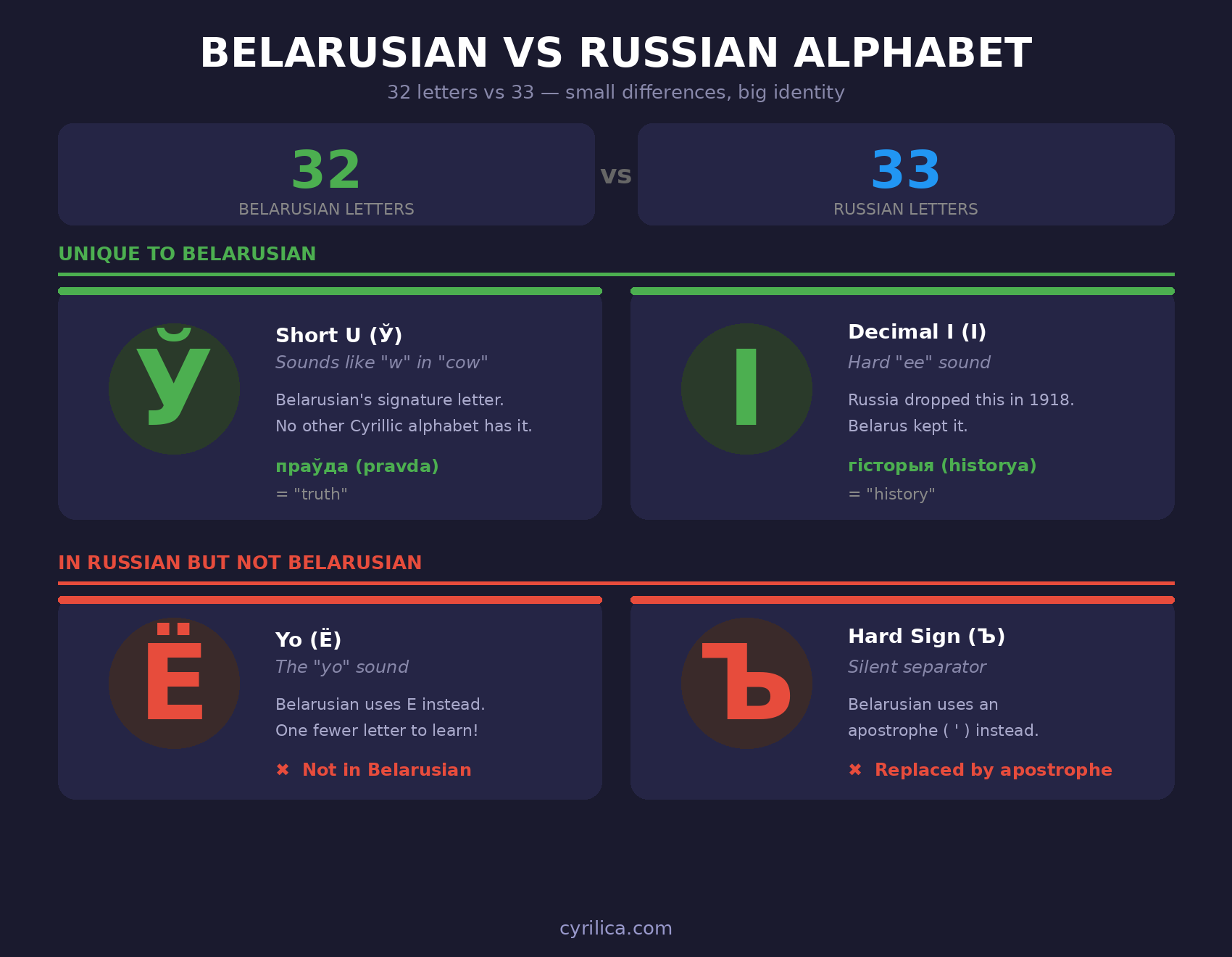
The Belarusian Alphabet: 32 Letters
Belarusian uses 32 letters compared to Russian's 33, and here is the surprise: Belarusian does have Ё, and it takes the letter more seriously than Russian does. Russian treats the two dots as optional and usually leaves them out, so readers have to guess. Belarusian writes Ё every time. The count comes out one lower because Belarusian drops three Russian letters and adds two of its own: Russian's 33, minus И, Щ and Ъ, plus І and Ў, makes 32.
Unique to Belarusian (not in standard Russian):
• Ў (short U): Represents a "w" sound, like the "w" in "now"
• І (decimal I): The hard "i" sound (Russian replaced this with И in 1918)
Missing from Belarusian (that Russian has):
• И (i): Belarusian writes this sound with І instead
• Щ (shch): not part of the Belarusian alphabet
• Ъ (hard sign): not used at all. Where Russian writes Ъ to separate a consonant from the vowel after it, Belarusian uses an apostrophe: аб'ект (object), where Russian has объект
The Most Important Letter: Ў
The letter Ў (called "ў нескладовае" or "non-syllabic u") is Belarusian's signature character. It doesn't exist in Russian and makes Belarusian instantly recognizable.
It sounds like the "w" in English "cow" or "how," a short, gliding sound that follows a vowel. In Russian, this sound is typically written as "в" but in Belarusian, it gets its own letter.
Examples:
Belarusian: праўда (praŭda) = truth
Russian: правда (pravda) = truth
Notice how Belarusian uses Ў where Russian uses В? That's the Ў in action.
The Return of І
Belarusian kept the letter І (decimal I) that Russian eliminated in 1918. This gives Belarusian two "i" sounds:
• І: hard "i" sound
• Ы: the difficult "y" sound (same as Russian)
Example:
Belarusian: гісторыя (historyja) = history
Russian: история (istoriya) = history
The use of І instead of И is one of the most visible differences between Belarusian and Russian texts.
How Different Is It From Russian?
If you know Russian, a lot of Belarusian will be comprehensible. Russian, Ukrainian and Belarusian retain a degree of mutual intelligibility, though putting a percentage on that is more precision than the evidence supports. The alphabet differences are small (two letters added, three dropped), but pronunciation and vocabulary differ more significantly.
Key differences:
Pronunciation: Belarusian tends to be softer, with more "a" sounds where Russian has "o" (called "akanne").
Grammar: Similar but with some differences in declension and conjugation patterns.
Vocabulary: Many Polish and Lithuanian influences due to historical ties.
A Tale of Two Orthographies
Here's where it gets interesting: Belarusian actually has TWO standard spelling systems:
1. Official/Soviet Orthography (1933)
This is the standard used in Belarus today. It was heavily influenced by Russian during the Soviet period and is the one you'll encounter in most Belarusian texts.
2. Taraškievica (1918)
Named after linguist Branisłaŭ Taraškievič, this older standard is used by some diaspora communities and nationalist movements. It's considered more authentically Belarusian and less Russified.
The differences are mostly spelling conventions, not different alphabets. Both use the same 32 letters.
Common Belarusian Words
Here are some words to get you started:
Прывітанне (pryvitanne) = Hello
Дзякуй (dziakuj) = Thank you
Так (tak) = Yes
Не (nie) = No
Беларусь (Bielarus) = Belarus
Мова (mova) = Language
The Political Dimension
Language in Belarus is politically complex. While Belarusian is one of two official languages (along with Russian), Russian dominates in daily life, especially in cities. How many people actually use it depends on what you count, and the gap between the measures is the real story. In the 1999 census, 85.6 percent of the population declared Belarusian their mother tongue, while 36.7 percent said it was the language they spoke at home. The 2019 census counted 5.09 million native speakers.
This has made Belarusian language a symbol of national identity and independence. Learning and using Belarusian is sometimes seen as a political statement supporting Belarusian independence from Russian influence.
Why Learn Belarusian?
If you're learning Russian, adding Belarusian requires minimal extra effort:
• One new letter (Ў) that's easy to pronounce
• One returned letter (І) that you might recognize from pre-revolutionary Russian texts
• Same basic grammar with minor variations
• Cultural access to Belarusian literature, music, and heritage
• Unique perspective on East Slavic languages
The Bottom Line
The Belarusian alphabet sits at the crossroads of Slavic linguistic heritage, preserving the old decimal I that Russian discarded, adding the unique Ў that neither Russian nor Ukrainian use, and creating a writing system that's distinctly Belarusian while remaining largely comprehensible to Russian speakers.
For learners of Cyrillic, Belarusian represents an easy expansion of your skills with just two key letters to learn. For those interested in Slavic culture, it's a window into a nation caught between East and West, using its language as a quiet assertion of identity.