Why Some Slavic Countries Use Latin Instead of Cyrillic
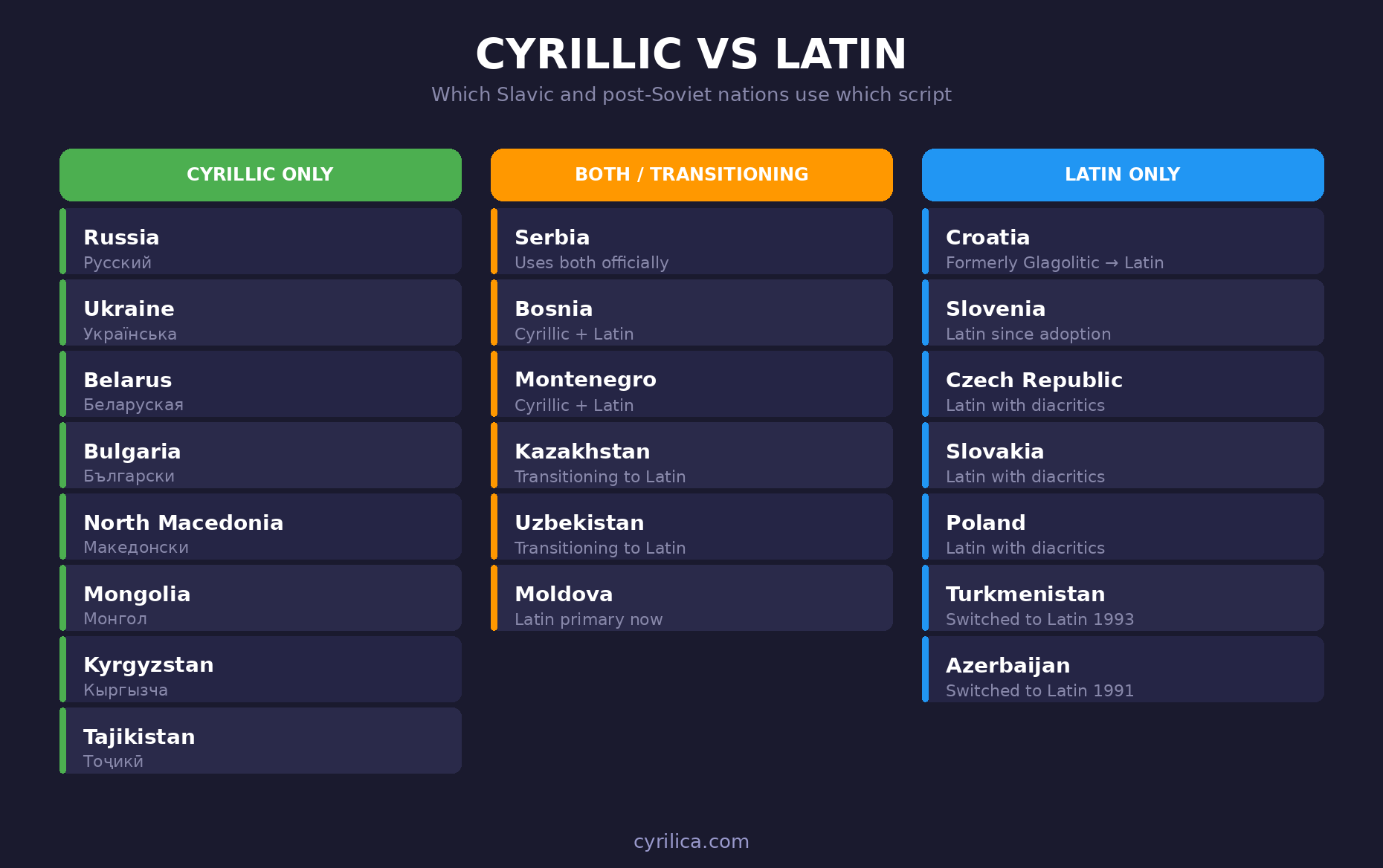
Walk through Eastern Europe and you'll notice something odd: some Slavic languages use Cyrillic (Russian, Ukrainian, Bulgarian, Serbian), while others use Latin alphabet (Polish, Czech, Croatian, Slovenian). These languages are all related: they're part of the same language family, so why the alphabet split?
The answer has nothing to do with linguistics and everything to do with religion, politics, and a thousand years of European history.
The Great Schism: The Root of the Split
In 1054 AD, Christianity split into two branches: Roman Catholicism (based in Rome) and Eastern Orthodoxy (based in Constantinople). This wasn't just a theological disagreement. It created a cultural fault line that runs through Europe to this day. The dividing line was older than the schism itself. Cyrillic's ancestor was already in Moravia in the 9th century, and Poland had chosen Rome in 966, so 1054 hardened a split that was already forming rather than creating it.
The alphabet followed the religion:
Catholic Slavs → Latin alphabet
Poland, Czech Republic, Slovakia, Croatia, Slovenia all became Catholic. The Catholic Church used Latin for liturgy, so these regions adopted the Latin alphabet for their written languages.
Orthodox Slavs → Cyrillic alphabet
Russia, Ukraine, Bulgaria, Serbia, Macedonia became Orthodox. The Orthodox Church used Old Church Slavonic (written in Cyrillic) for liturgy, so these regions adopted Cyrillic.
The alphabet you use became a marker of religious and cultural identity. Writing in Latin meant "we're part of Western Europe." Writing in Cyrillic meant "we're part of the Eastern Orthodox world."
The Geographic Divide
If you draw a line through Europe roughly following the old Iron Curtain, you can predict which Slavic languages use which alphabet:
West of the line (Catholic influence):
• Polish - Latin alphabet
• Czech - Latin alphabet
• Slovak - Latin alphabet
• Slovene - Latin alphabet
• Croatian - Latin alphabet
East of the line (Orthodox influence):
• Russian - Cyrillic alphabet
• Ukrainian - Cyrillic alphabet
• Belarusian - Cyrillic alphabet
• Bulgarian - Cyrillic alphabet
• Serbian - Cyrillic alphabet (though they also use Latin)
• Macedonian - Cyrillic alphabet
This geographic pattern holds remarkably well. The further west and Catholic a Slavic region is, the more likely it uses Latin. The further east and Orthodox, the more likely it uses Cyrillic.
The Polish Exception: Why Poland Uses Latin
Poland is the largest Slavic country using the Latin alphabet. Why?
966 AD: Poland's Baptism
Poland's Duke Mieszko I converted to Catholicism (not Orthodoxy). This single decision locked Poland into the Western/Latin sphere rather than the Eastern/Cyrillic sphere.
Political alignment:
Poland aligned with the Holy Roman Empire and Western European powers. This meant Latin literacy, Latin-based education, and eventually a Latin alphabet for Polish.
The result:
Polish uses Latin letters with added diacritics: ą, ć, ę, ł, ń, ó, ś, ź, ż. These modify Latin letters to represent Polish sounds that don't exist in standard Latin.
Meanwhile, Russia (Poland's neighbor and historical rival) went Orthodox and Cyrillic. The alphabet difference reinforced the cultural and political divide between them.
The Czech and Slovak Story
The Czechs and Slovaks are interesting because they're right on the border between Catholic and Orthodox influence.
Early history:
In the 9th century, Saints Cyril and Methodius actually brought the Glagolitic alphabet (predecessor to Cyrillic) to Moravia (modern Czech Republic/Slovakia). For a brief period, these regions used a Cyrillic-like script.
What changed:
Political pressure from the Holy Roman Empire pushed these regions toward Catholicism and Latin. By the 11th century, Latin had won. Czech and Slovak became written in Latin alphabet.
So the very region where Cyrillic's ancestor was first developed ended up using Latin instead. History is ironic.
The South Slavic Split: Croatian vs Serbian
Croatian and Serbian are so similar they're often considered the same language (Serbo-Croatian). Yet one uses Latin, the other Cyrillic. Why?
Religion, again:
Croatians → Catholic → Latin alphabet
Croatia fell under Catholic influence from Austria-Hungary and Venice. They adopted Latin alphabet.
Serbians → Orthodox → Cyrillic alphabet
Serbia stayed Orthodox under Byzantine and later Ottoman influence. They used Cyrillic.
During Yugoslavia (1918-1991), both alphabets were officially used. Post-breakup, the alphabet became a political identity marker again:
• Croatia emphasizes Latin script
• Serbia emphasizes Cyrillic script
• Bosnia uses both (it's ethnically/religiously mixed)
Same language, different alphabets, different national identities. The alphabet isn't just a writing system. It's a statement about who you are. Learn more about this unique linguistic situation in our article on Serbian: one of the few languages written in both scripts.
Why Not Just Pick One?
Couldn't Slavic languages just standardize on one alphabet and make everything easier?
In theory, yes. In practice, impossible.
By the time anyone thought to standardize, the alphabet had become tied to:
• Religious identity (Catholic vs Orthodox)
• National identity (Polish vs Russian, Croatian vs Serbian)
• Political alignment (Western vs Eastern Europe)
• Centuries of literature and tradition
Asking Poland to switch to Cyrillic would be like asking them to renounce their Catholic heritage and Western European identity. Not happening.
Asking Russia to switch to Latin would be like asking them to abandon Orthodox tradition and align with the West. Also not happening.
The alphabets are too culturally loaded to change now.
The Ottoman Empire's Role
The Ottoman Empire (Muslim, Turkish) conquered much of the Balkans for 500+ years. You might expect this would introduce Arabic script. It didn't, for Slavic languages at least.
Why Cyrillic survived Ottoman rule:
The Ottoman Empire allowed religious communities (millets) to maintain their own scripts. Orthodox Christians kept using Cyrillic for church and education.
When Ottoman rule ended, Balkan Slavs didn't adopt Arabic script. They returned to or maintained Cyrillic (Bulgaria, Serbia, Macedonia) or Latin (Croatia, Slovenia).
The religious identity (Orthodox = Cyrillic, Catholic = Latin) was too strong to overwrite.
The Communist Period
During the Soviet era (1945-1991), the USSR tried to expand Cyrillic's use:
• Non-Slavic Soviet languages were forced to adopt Cyrillic
• Mongolia switched from traditional script to Cyrillic
• Eastern European countries under Soviet influence kept Cyrillic where it existed
But the USSR couldn't force Catholic/Latin countries like Poland or Czechoslovakia to switch. The cultural resistance was too strong.
After 1991, many formerly Soviet countries ditched Cyrillic:
• Moldova (Romanian) switched back to Latin
• Azerbaijan, Turkmenistan, Uzbekistan switched to Latin
• Kazakhstan is switching to Latin by 2031
For these countries, Cyrillic represented Soviet domination. Switching to Latin was an act of independence.
Modern Implications
Today, the Cyrillic/Latin divide still matters:
Technology:
Latin alphabet countries integrate more easily with Western tech standards (URLs, programming, keyboards). Cyrillic countries need special keyboard layouts and Unicode support.
EU Integration:
Several Latin-alphabet Slavic countries (Poland, Czech Republic, Slovakia, Slovenia) joined the EU together on 1 May 2004. The pattern is not clean, though. Croatia also uses the Latin alphabet and joined years later than Bulgaria, which uses Cyrillic. The alphabet tracks Western versus Eastern orientation loosely, not reliably.
Cultural Identity:
The alphabet you use still signals your cultural-political alignment. Latin = Western, democratic, European. Cyrillic = Eastern, Orthodox, Russian-sphere.
These associations aren't fair or accurate, but they exist.
The Bottom Line
Slavic languages split into Latin and Cyrillic not because one alphabet is better, but because they followed different churches, Catholic Rome and the Orthodox Church, a division that began before the 1054 schism.
Catholic Slavs ended up in the Western/Latin sphere. Orthodox Slavs ended up in the Eastern/Cyrillic sphere. A thousand years later, we're still living with that division.
So when you see Polish written in Latin and Russian written in Cyrillic, you're not just seeing two alphabets. You're seeing the legacy of medieval Christianity's split, centuries of political rivalry, and deeply rooted cultural identities.
The alphabet is never just an alphabet. It's history written on the page.