Serbian: Cyrillic vs Latin Scripts
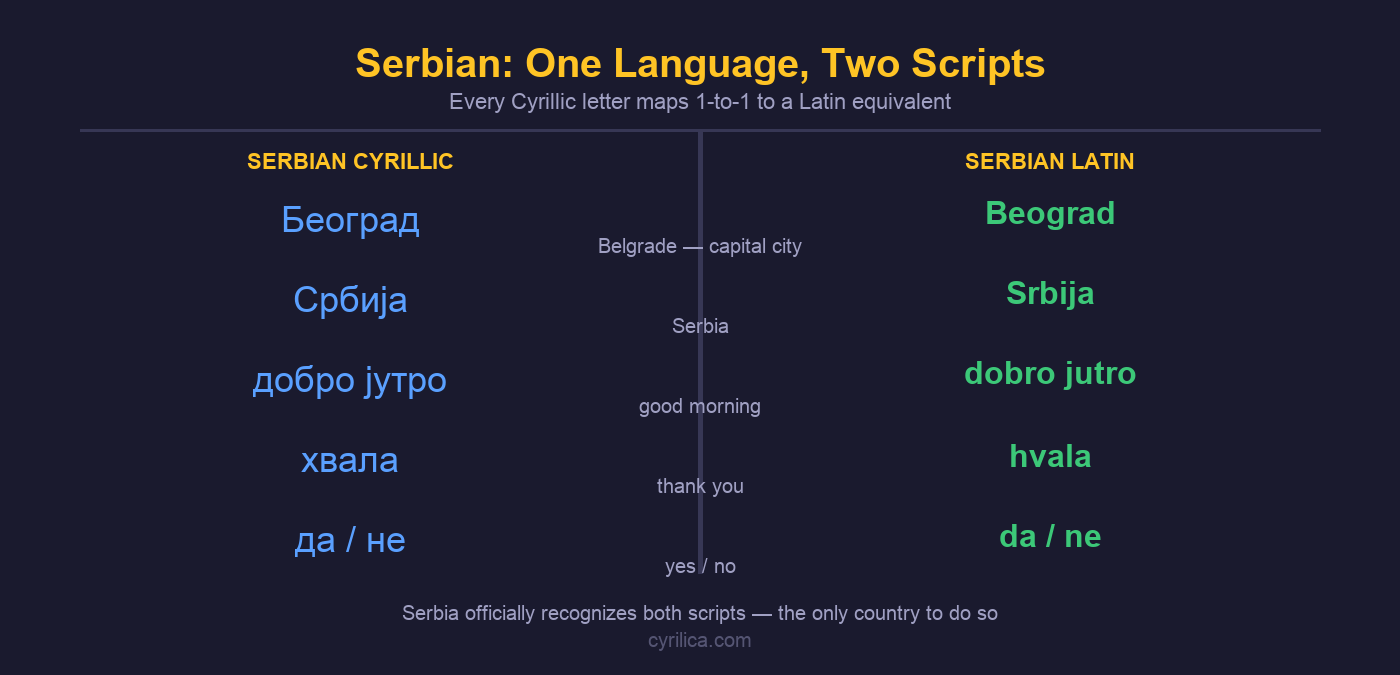
Serbia is kind of unique. It's one of the only countries in the world that uses two completely different alphabets for the same language, side by side and in everyday life. Walk down a street in Belgrade and you'll see signs in Cyrillic right next to signs in Latin. Sometimes the same word written both ways on the same sign.
This isn't like how some countries are bilingual. This is one language, Serbian, written two different ways. And in practice both are treated as equally correct.
Why Two Alphabets?
The short answer: history is messy.
Serbia used Cyrillic for centuries. It was part of their cultural and religious identity, connected to the Orthodox Church and the legacy of Saints Cyril and Methodius. Cyrillic was the alphabet of literature, government, and education.
But Serbia also spent time under Austro-Hungarian influence, where Latin script dominated. And when Yugoslavia formed in the 20th century, there was a push to standardize across different South Slavic languages, some of which used Latin (like Croatian).
Instead of picking one alphabet and making everyone switch, Serbia just said: we'll use both. That has held ever since, even though the two scripts have never had quite the same legal footing.
The Latin Alphabet (Latinica)
Serbian Latin isn't quite the same as English Latin. It uses some special characters to represent sounds that don't exist in English.
Letters like č, ć, š, ž, and đ. These are borrowed from Czech and Croatian orthography. Each one represents a specific Slavic sound.
For example, "č" makes a "ch" sound (like in "church"). "š" makes a "sh" sound (like in "shoe"). "ž" is the "zh" sound (like the s in "measure").
If you know the Latin alphabet, you can learn Serbian Latinica pretty quickly. The special characters take some getting used to, but the basic structure is familiar.
The Cyrillic Alphabet (Ćirilica)
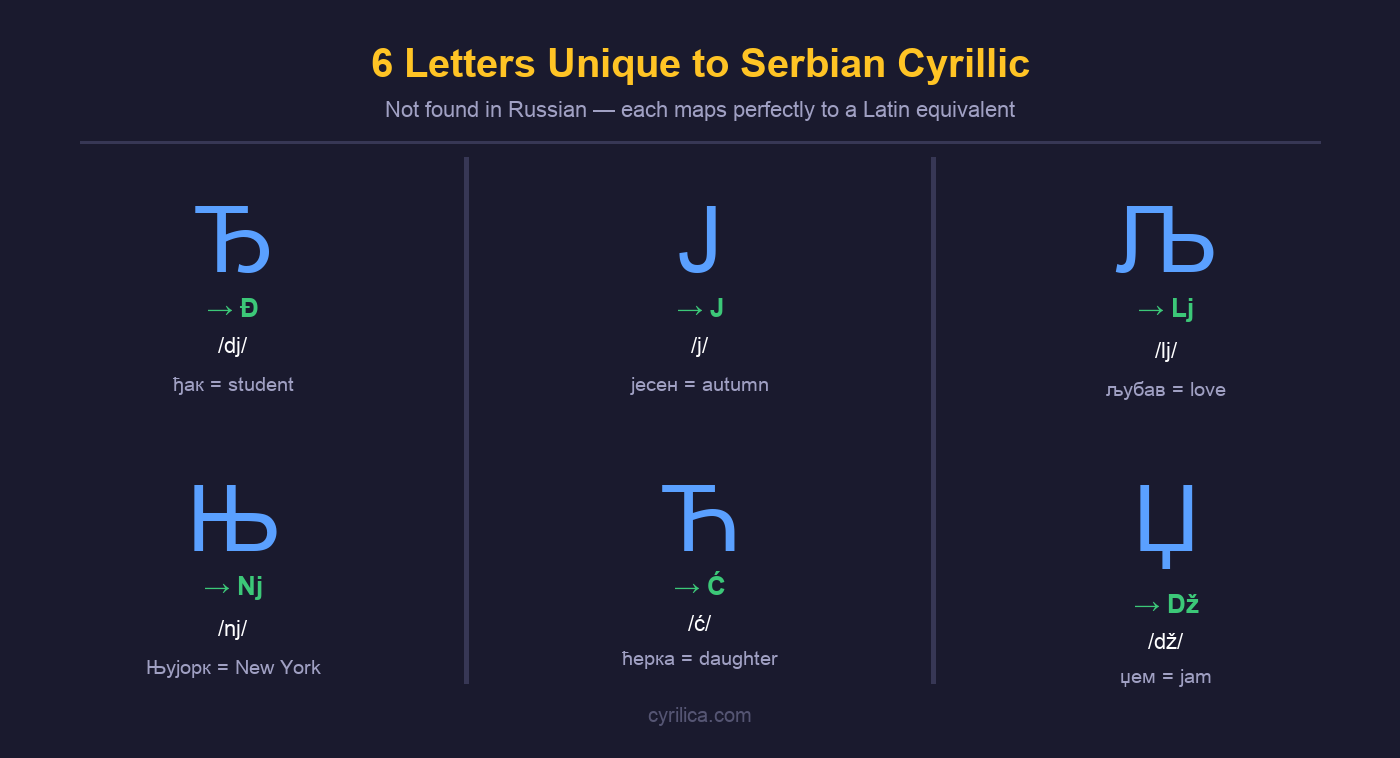
Serbian Cyrillic and Russian Cyrillic are cousins rather than parent and child: both descend from Early Cyrillic. Serbian's modern shape comes from Vuk Karadžić's reform, adopted in 1868, which deliberately moved the alphabet away from Russian Church Slavonic and towards everyday speech. He discarded 18 letters, took Ј from the Latin alphabet, Ћ from old Serbian manuscripts and Џ from old Romanian ones. It has 30 letters, compared to Russian's 33.
The key difference: Serbian doesn't use some of the Russian letters like Ё, Ъ, Ы, and Э. And it has six letters Russian doesn't: Ђ and Ћ, which Macedonian lacks, and Ј, Љ, Њ and Џ, which it shares with Macedonian. Ј makes a "y" sound like in "yes".
Serbian Cyrillic is also more phonetic than Russian. Generally, one letter equals one sound. No complicated spelling rules or silent letters. If you can read it, you can pronounce it.
Which One Do Serbians Use More?
This is a surprisingly political question.
In law, the two are not equal. Article 10 of the constitution puts only the Serbian language and the Cyrillic script into official use, and leaves other scripts, Latin included, to ordinary legislation. In daily life, though, they work as interchangeable. Schools teach both, everyone is expected to read both, and Serbian is one of the few languages in the world where the same text can appear in either script without anyone blinking. Cyrillic dominates official communication, and Latin dominates business and the marketplace.
But in practice? It depends on context and sometimes personal preference.
Younger people tend to use Latin more, especially online. It's easier to type on Western keyboards. Social media, texting, and internet communication lean heavily toward Latin.
Older generations and more traditional/nationalist folks prefer Cyrillic. It's seen as more authentically Serbian, more connected to history and culture.
Official documents, newspapers, and books often use Cyrillic. But you'll also find plenty of Serbian media entirely in Latin.
Basically, if you're learning Serbian, you need to learn both. You can't just pick one and ignore the other.
The Conversion Is Easy (Once You Know Both)
Here's the good news: there's a direct one-to-one mapping between Serbian Latin and Serbian Cyrillic. Every Latin letter has an exact Cyrillic equivalent, and vice versa.
For example:
Latin "j" = Cyrillic "ј"
Latin "č" = Cyrillic "ч"
Latin "š" = Cyrillic "ш"
Latin "ž" = Cyrillic "ж"
So once you learn the alphabet, you can actually read the same text in both scripts. The words are spelled the same way, just with different symbols.
This is different from, say, Russian to English transliteration, where there are multiple ways to romanize the same word and no standard conversion.
Learning Strategy
If you're learning Serbian from scratch, most people recommend starting with Cyrillic. Here's why:
First, it forces you to actually learn the sounds properly. With Latin, English speakers tend to guess at pronunciation based on English rules, which leads to mistakes. Cyrillic forces you to learn each letter from scratch.
Second, once you know Cyrillic, switching to Latin is easy. You already know the sounds, you're just learning new symbols. Going the other direction (Latin first, Cyrillic later) is harder because you have to unlearn bad pronunciation habits.
Third, a lot of important historical and literary texts are in Cyrillic. If you want to read original sources, you need Cyrillic.
But honestly, you'll need both eventually. So just pick one, get comfortable with it, then add the other.
The Cultural Angle
The Cyrillic vs Latin debate isn't just about practical communication. It's tied up in identity, politics, and history.
Some Serbians see Cyrillic as an essential part of Serbian identity. Losing Cyrillic would be losing part of what makes Serbia distinct from its neighbors.
Others see the dual alphabet system as practical and modern. Why limit yourself to one script when you can use both?
And some younger Serbians honestly don't care that much. They use whichever alphabet is more convenient at the moment, without overthinking it.
As a learner, you don't have to pick a side in this debate. Just learn both alphabets and appreciate that Serbia managed to keep both alive instead of forcing everyone to choose.
Quiz: The 6 Unique Serbian Letters
Type the romanization for each letter. Use: dj, j, lj, nj, ch, dzh