Ukrainian Cyrillic: The Alphabet That Sets Ukrainian Apart
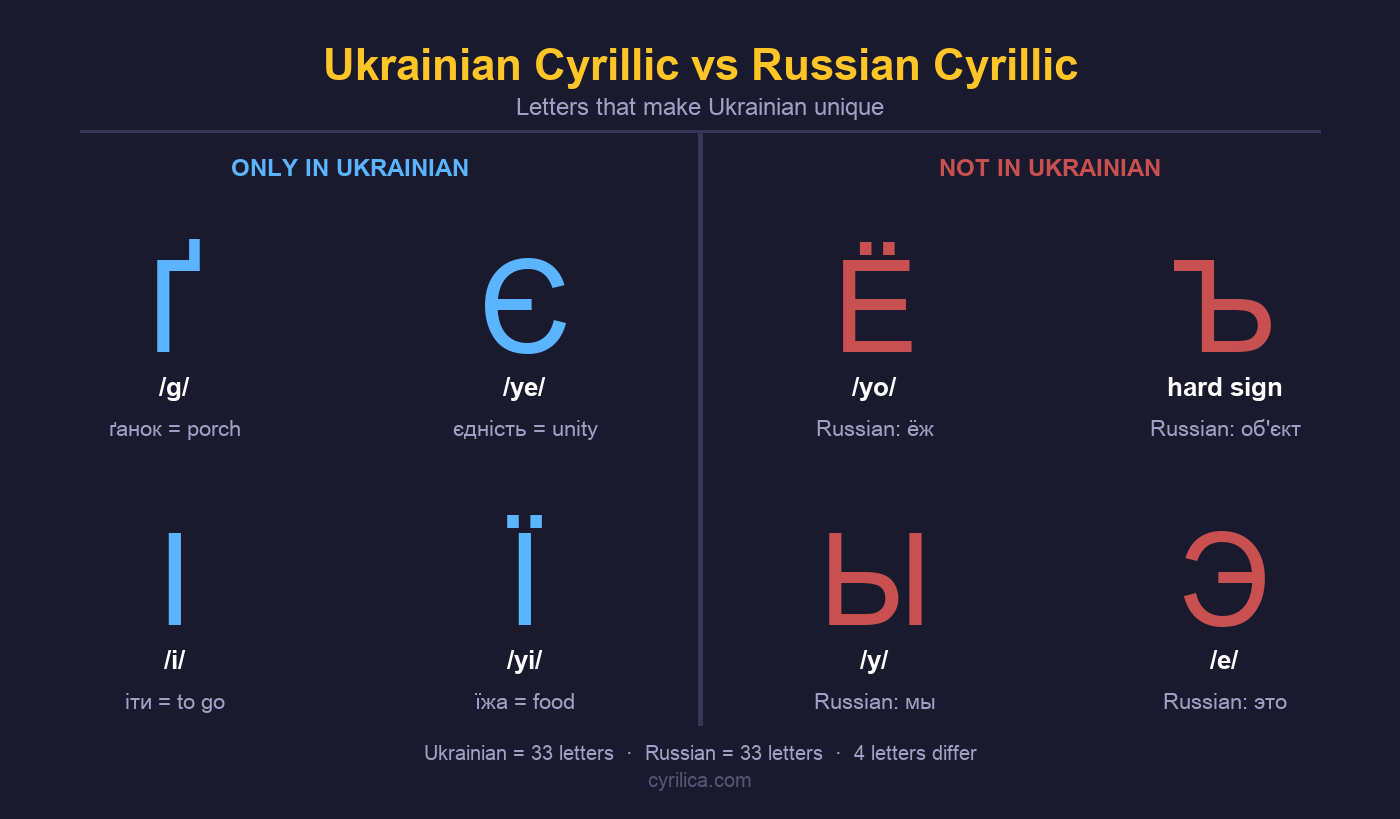
Ukrainian is the third most-spoken Slavic language, and it uses Cyrillic, but not the same Cyrillic as Russian. About 32 million people speak it natively, closer to 39 million counting second-language speakers. The two alphabets share 29 letters. Four letters exist only in Ukrainian. Four Russian letters don't appear in Ukrainian at all. Those eight characters are where the whole story lives.
The Ukrainian Alphabet: 33 Letters
Ukrainian has 33 letters, the same count as Russian, but it's a different 33. The alphabet is arranged slightly differently, reads differently in places, and sounds different enough that the two languages aren't mutually intelligible to untrained ears, despite being closely related.
If you already know Russian Cyrillic, you can read most Ukrainian text. You'll recognize the majority of letters and can sound out words, even if you don't understand them. But four letters will stop you immediately, specifically the ones Russian doesn't have.
The Four Letters Only Ukrainian Has
These are the letters that mark a text as Ukrainian, not Russian:
Ґ (ґ): Hard G
Pronounced like the "g" in "get," a hard, voiced stop. Russian uses Г for a softer fricative "g" sound. Ukrainian has both: Г for the softer sound and Ґ for the hard stop. Examples: ґанок (porch), ґрунт (soil). This letter was suppressed during the Soviet period and only formally restored to the Ukrainian alphabet in 1990.
Є (є): YE sound
Sounds like "ye" in "yes." Russian has Е for a similar sound, but Ukrainian's Є is visually distinct. It is the mirror image of the Russian Э. It's one of the first letters that marks a text as unmistakably Ukrainian. Examples: єдність (unity), Європа (Europe).
І (і): Pure I sound
The clean "ee" sound, like in "see." Russian eliminated this letter in the 1918 spelling reform, replacing it with И. Ukrainian kept it, and it appears far more frequently than И does. Historically called "і десяткове" (decimal i). Examples: іти (to go), місто (city), він (he).
Ї (ї): YI sound
This one has no direct Russian equivalent. It's a two-sound letter, "y" + "i" combined, like saying "yee" quickly. It's always pronounced with that initial "y" glide, never as a plain "i." Examples: їжа (food), їхати (to travel), Україна (Ukraine, the і in Украї is this letter).
The study tool drills the 33 letters of the Russian alphabet, which share most of their shapes with Ukrainian. It does not include Ґ, Є, І or Ї, so use it for the shared letters and this page for the four Ukrainian ones. Pick your character groups and start practicing.
The Four Russian Letters Ukrainian Doesn't Use
Going the other direction, here are letters Russian has that Ukrainian dropped:
Ё (ё): YO sound
Ukrainian uses the combination Йо or relies on context instead. The absence of Ё is one reason Ukrainian spelling is considered more phonetically straightforward. You can read more about Ё's complicated history in Russian in our article on Russia's most controversial letter.
Ъ (ъ): Hard Sign
Russian uses this to create a pause or separation between sounds. Ukrainian replaces it entirely with an apostrophe ('). So Russian объект becomes Ukrainian об'єкт (same pronunciation, different notation).
Ы (ы): The difficult Y sound
One of the hardest sounds for English speakers learning Russian. Ukrainian doesn't use it. The Ukrainian И fills a similar role but sounds slightly different, closer to the English "i" in "bit" than the deeper Russian Ы.
Э (э): Plain E sound
Russian uses Э for a plain "e" sound without any "y" glide. Ukrainian simply uses Е for this, keeping the alphabet leaner.
How Different Is Ukrainian From Russian?
Linguists classify Ukrainian and Russian as distinct languages in the East Slavic branch, alongside Belarusian. They share a common ancestor in Old East Slavic but diverged significantly over centuries of different political and cultural influences. Ukrainian absorbed more Polish and Central European vocabulary, while Russian developed under different pressures from the east and north.
Mutual intelligibility is real but limited. Russian speakers can often follow written Ukrainian reasonably well, since shared vocabulary is high. Spoken Ukrainian is harder, especially as pronunciation differs more than spelling alone suggests. Ukrainian vowels are more stable and less reduced than Russian ones.
For learners of the Cyrillic script, Ukrainian is often described as more phonetic than Russian: what you see is generally what you pronounce, with fewer pronunciation rules to memorize. The apostrophe replacing the hard sign is one example of this streamlining.
If you're coming from Russian Cyrillic, the script barrier is low, just four new letters to learn. Pronunciation takes longer; vocabulary and grammar longer still. But you can start reading Ukrainian text almost immediately. Compare this to the Belarusian alphabet, where the gap from Russian is similarly small.
Language as Identity: Post-2014 and 2022
Ukrainian has been politically charged for a long time. The language was suppressed under the Russian Empire (the Ems Decree of 1876 banned Ukrainian-language publishing entirely) and was severely restricted under Stalin in the 1930s. The language survived through diaspora communities, underground literature, and stubborn persistence.
After Russia's annexation of Crimea in 2014, and especially after the full-scale invasion in 2022, the language question became acute inside Ukraine itself. Millions of Russian-speaking Ukrainians switched to Ukrainian as a deliberate statement of cultural and national identity. Language schools saw massive enrollment increases. Ukrainian stopped being a regional marker and became a symbol of nationhood.
For the wider world, this brought a surge of interest in learning Ukrainian, and the alphabet is always the first step. The history of Cyrillic includes many moments where script and political power were intertwined. The Ukrainian case is one of the clearest modern examples.
Common Ukrainian Words to Start With
A handful of words to get the unique letters working in your head:
Привіт (pryvit) = Hello
Дякую (dyakuyu) = Thank you
Так (tak) = Yes
Ні (ni) = No
Мова (mova) = Language
Україна (Ukrayina) = Ukraine
Київ (Kyiv) = Kyiv
Їжа (yizha) = Food
Єдність (yednist) = Unity
Ґанок (ganok) = Porch
Tips if You Already Know Russian Cyrillic
Your existing knowledge gets you roughly 85% of the way there. Here's where to focus the rest:
Ї is the only completely new sound. Practice the "yi" glide until it's automatic. Є is the mirror image of the Russian Э; visually distinctive and easy to learn. І looks identical to the Latin letter i, which makes it simple to recognize but can cause momentary confusion when reading quickly mixed-script text.
The trickier adjustment isn't learning the new letters. It's resisting the assumption that similar-looking words mean the same thing. Ukrainian and Russian have substantial vocabulary overlap but also plenty of false friends. The script is the easy part. The words are where the real work is.
Start with the four unique letters. Read some Ukrainian headlines or menus. The script will click faster than you expect.